

Electric vehicles have moved from early adoption into a defining force in global mobility. In 2026, they represent a growing share of new car sales worldwide and are influencing everything from energy systems to urban planning and consumer behavior. With global electric car sales projected to reach 23 million units this year—accounting for about 28 percent of all new cars sold—the shift is accelerating and expanding beyond traditional leading markets.
This transformation builds on strong momentum from 2025, when sales surpassed 20 million and electric models made up one-quarter of new car purchases. The change is reshaping transportation by reducing reliance on fossil fuels, improving efficiency, and driving innovations in batteries, charging, and vehicle design.
Global Adoption Trends in 2026
Sales growth remains robust overall, even as patterns vary by region. Europe is positioned for significant expansion, with projections pointing to roughly one in three new cars being electric. China continues as the volume leader, with battery electric vehicles holding a substantial market share and the country dominating global production and battery supply chains. Emerging markets in Southeast Asia, including Vietnam and Thailand, have recorded notably high adoption rates in the first half of the year, sometimes matching or exceeding levels seen in more established markets.
North America has faced slower progress relative to other regions, influenced by policy shifts. Outside the major markets of China, Europe, and the United States, growth in places such as Latin America and broader Asia-Pacific has been strong, with many countries setting monthly sales records. Chinese manufacturers supply a large portion of vehicles sold globally, and exports have risen as domestic production outpaces local demand in some periods.
These trends indicate that electric vehicles are no longer confined to a few pioneering countries. Broader availability of models—potentially exceeding 1,100 electric car options this year—combined with improving affordability is helping drive the next wave of adoption.
Advances in Battery Technology and Vehicle Performance
Batteries remain the core of electric vehicle progress. Deployment reached 1.2 terawatt-hours in 2025, nearly 30 percent higher than the prior year, while average prices declined by about 8 percent. Lithium iron phosphate chemistries have gained prominence, accounting for more than half of global deployment. Newer designs emphasize higher energy density, faster charging, and better performance in varied conditions.
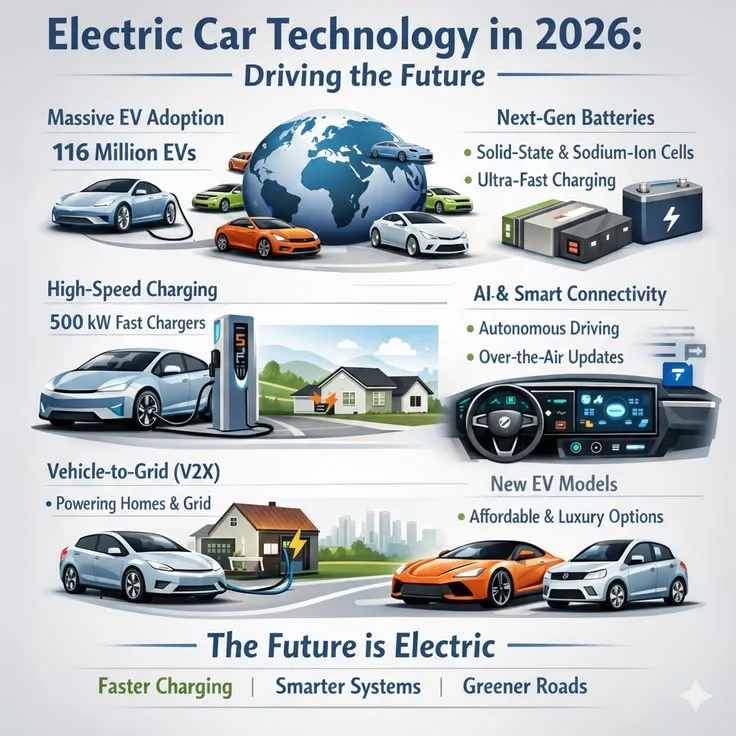
Charging times continue to improve. Models supporting 1,000-volt systems appeared in 2025, and announcements of charges under 10 minutes have carried into 2026. These developments address one of the longstanding practical barriers for many drivers. Range has also expanded across new models, with efficiency gains allowing longer distances without continuously larger battery packs. Software-defined vehicle architectures further enable remote updates and enhanced features, positioning battery electric vehicles at the forefront of connected mobility.
Heavy-duty segments are advancing as well. Electric truck sales have grown substantially, particularly in China, with medium- and heavy-freight options beginning to gain traction in Europe.
Expanding Charging Infrastructure and Energy Integration
Public charging networks have expanded in parallel with vehicle sales. The global stock of public charging points grew by more than 33 percent in 2025, adding nearly 1.8 million points. Utilization rates have in some cases outpaced the addition of new ports, highlighting rising demand. Ultra-fast charging capabilities (150 kW and above) are becoming more common, supporting longer-distance travel and fleet operations.
Home and workplace charging remain central for many owners, while public networks focus on high-power hubs along highways and in urban areas. Emerging vehicle-to-everything capabilities allow electric vehicles to interact with the grid, potentially helping manage peak demand and integrate renewable energy. However, infrastructure growth must keep pace with vehicle numbers to sustain momentum, particularly for commercial fleets and in regions still building out coverage.
Environmental and Economic Impacts
Electric vehicles deliver clear benefits in reducing oil demand and greenhouse gas emissions. The global fleet displaced approximately 1.2 million barrels of oil per day in 2025. Lifecycle analyses show battery electric cars produce substantially lower greenhouse gas emissions than gasoline or diesel equivalents—often 40 to 70 percent or more depending on the electricity mix and vehicle type—while also cutting local air pollutants that affect urban health.
Running costs are typically lower due to higher energy efficiency and reduced maintenance needs. In many markets, the total cost of ownership has become competitive or favorable even without incentives, especially as battery prices fall and fuel price volatility increases interest. For consumers, this translates to savings over the vehicle’s lifetime in most regions.
Challenges remain. Battery production involves resource extraction and manufacturing emissions that must be managed through cleaner supply chains, recycling, and lower-impact chemistries. Grid capacity and electricity sources influence the full environmental gains, underscoring the importance of continued power-sector decarbonization. Regional differences in incentives, infrastructure, and energy prices also shape the pace of change.
Broader Changes to Transportation Systems
Beyond individual cars, electric vehicles are influencing freight, public transit options, and urban design. Software and connectivity features support smarter routing, predictive maintenance, and integration with shared mobility services. Falling battery costs and greater model variety are making electric options accessible to more buyers, including in price-sensitive segments.
Policy frameworks, manufacturing localization efforts, and consumer responses to energy costs continue to shape outcomes. Markets that pair vehicle incentives with charging investment and grid readiness tend to see faster progress. At the same time, the technology itself—longer ranges, rapid charging, and refined vehicle platforms—is reducing practical barriers that once limited appeal.
Looking Ahead
By the end of 2026, electric vehicles are expected to account for nearly 30 percent of global new car sales. The trajectory points toward continued growth in the years ahead, with the global fleet expanding significantly. Success will depend on sustained improvements in battery economics, reliable charging access, and supportive energy systems.
Electric vehicles are no longer a niche alternative. They are actively redefining efficiency standards, emissions profiles, and the economics of personal and commercial transport. As adoption broadens and technology matures, the transportation landscape of the late 2020s will look markedly different from the one dominated by internal combustion engines just a decade earlier. The progress visible in 2026 demonstrates both how far the transition has come and the remaining work required to fully realize its potential.
Read more – gloryhouseworld.com
