
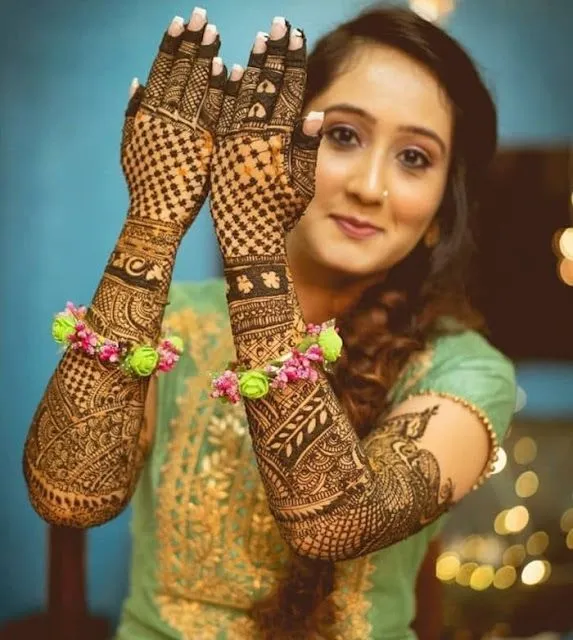

Contemporary Arabic Mesh Mehndi has redefined the way modern brides approach body art, blending the airy elegance of negative space with the structured precision of traditional latticework. Imagine sitting in a sun-drenched courtyard where the scent of eucalyptus and fresh henna paste hangs heavy in the air. As the artist begins to work, she doesn’t just draw flowers; she weaves a delicate net of ink across the skin that looks more like a silk glove than a traditional tattoo. This style has captured the hearts of women globally because it offers a sophisticated, jewelry-like finish that complements both heavy bridal lehengas and sleek evening gowns. It is the perfect choice for someone who values the “less is more” philosophy while still wanting to honor the rich cultural history of henna.
The allure of this specific aesthetic lies in its sheer technical difficulty. While traditional styles might rely on broad strokes and filled-in leaves, the mesh or “jali” work requires an incredibly steady hand and a deep understanding of spatial geometry. Each line must be equidistant, and every intersection must be clean to achieve that authentic lace effect. When the henna eventually stains the skin, the result is a high-contrast pattern where the natural skin tone acts as a primary design element. This interaction between the dark mahogany of the dye and the warmth of the skin creates a three-dimensional depth that is often missing from more densely packed designs.
The evolution of Contemporary Arabic Mesh Mehndi is a testament to how art adapts to the changing lifestyles of the women who wear it. In the past, henna was often a symbol of abundance, with every millimeter of the hand covered in intricate patterns. However, as modern fashion moved toward minimalist silhouettes and statement jewelry, henna followed suit. Today’s designs often leave the center of the palm or the back of the hand completely bare, allowing a diamond ring or a gold bracelet to take center stage. It is a harmonious collaboration between body art and personal adornment, ensuring that neither overwhelms the other.
The Artistic Philosophy of Contemporary Arabic Mesh Mehndi
To truly appreciate the mastery involved in these designs, one must look at the balance between bold Arabic motifs and the fine netting of the mesh. Traditional Arabic henna is known for its succulent floral clusters and flowing vines that travel diagonally across the hand. The contemporary twist introduces a rigorous grid system within these organic shapes. You might see a large, bold rose where the petals are not solid but filled with a microscopic honeycomb pattern. This juxtaposition of the “heavy” and the “light” is what gives the style its signature modern edge.
The mastery of the artist is revealed in how they handle the “bleeding” of the henna. Because natural henna is a liquid botanical dye, it has a tendency to spread slightly as it dries and oxidizes. A novice artist might find their mesh patterns merging into a solid blob, but a professional knows exactly how to adjust the consistency of the paste to maintain those razor-thin lines. They use a specific blend of finely sifted henna powder and essential oils like tea tree or cajeput to ensure the paste is “stringy” enough to pull long, straight lines across the knuckles and palms without breaking.
Storytelling often plays a subtle role in these designs. Many artists will hide small, significant symbols within the mesh, such as the couple’s initials or a tiny heart, creating a private game of discovery for the bride and groom. This personalized touch transforms the henna from a standard bridal ritual into a unique piece of contemporary art. It becomes a visual diary of a celebration, etched temporarily into the skin but remembered for a lifetime through wedding photography and shared memories. It is this emotional resonance that keeps the mesh style at the forefront of bridal trends year after year.
Technical Precision in Contemporary Arabic Mesh Mehndi Application
Achieving the perfect grid requires more than just artistic talent; it requires the discipline of a mathematician. The artist often begins with a few anchor points, marking the center of the wrist and the tips of the fingers. From there, they build a skeletal structure of lines that serve as the foundation for the mesh. If the initial grid is even slightly off, the entire design will look lopsided. This is why many professionals spend a significant amount of time just on the “framing” of the piece before they ever start on the intricate internal details.
The pressure exerted on the henna cone is another critical factor. To get that consistent, hair-thin line, the artist must maintain a constant, steady squeeze. Any fluctuation in pressure will cause the line to thicken or thin out, ruining the lace-like appearance. It is a physically demanding task that requires years of muscle memory. When you watch a seasoned pro at work, you notice how they use their entire arm to pull a line, ensuring that the movement is smooth and uninterrupted. This level of craftsmanship is what differentiates a high-end bridal artist from a casual hobbyist.
Beyond the linework, the use of “shading” within the mesh is a relatively new innovation in the contemporary scene. By using a slightly diluted henna paste or a “brushing” technique, artists can create shadows and highlights within the grid. This makes the mesh look like it is draping over the hand like actual fabric. When the stain matures, these shaded areas result in lighter tones of orange and amber, while the solid lines stay a deep, dark brown. This multi-tonal effect adds a layer of luxury and sophistication that is the hallmark of the modern Arabic aesthetic.
Cultural Fusion and Global Appeal
While the roots of this style are firmly planted in Middle Eastern traditions, the contemporary mesh movement has become a global phenomenon. In India and Pakistan, this style is often merged with traditional Indian motifs like peacocks or elephants, creating a stunning “Indo-Arabic” fusion. The mesh provides a modern background for these classical symbols, making them feel fresh and relevant for a new generation. This cross-pollination of cultures has led to a vibrant exchange of ideas, where artists from Dubai, Mumbai, and London inspire one another through social media platforms.
The versatility of the mesh pattern is one of its greatest strengths. It can be adapted to suit any personality, from the ultra-minimalist who only wants a small patch of netting on her finger to the maximalist who wants a full sleeve of lace-inspired art. Because the grid can be scaled up or down, it works on any part of the body. We are seeing an increase in brides requesting mesh patterns on their feet and ankles, creating the illusion of delicate, permanent anklets or silk stockings. This adaptability ensures that the style remains inclusive and accessible to everyone, regardless of their cultural background.
Trustworthiness in the henna industry is built on the quality and safety of the ingredients. A professional artist specializing in Contemporary Arabic Mesh Mehndi will always use 100% natural henna. They take pride in their secret recipes, which often include high-quality essential oils that not only darken the stain but also provide an aromatherapeutic experience for the bride. They avoid “black henna” at all costs, as the chemical PPD can cause severe allergic reactions and scarring. By prioritizing skin health and the natural oxidation process, these artists build long-term relationships with their clients based on expertise and care.
Maintaining the Integrity of the Mesh Stain
Once the paste is removed, the true magic of the design begins to reveal itself. The stain starts as a bright, neon orange, which can be alarming to first-timers. However, over the next 48 hours, the lawsone pigment reacts with the oxygen in the air and the proteins in the skin to darken into a rich, mahogany brown. For a mesh design, this oxidation process is crucial. The thinness of the lines means that the stain must be as dark as possible to maintain visibility. Brides are often advised to avoid water for the first 24 hours and to keep the area warm to encourage the deepest possible color.
The aftercare for a mesh design is a ritual in itself. Many cultures recommend applying a mixture of lemon juice and sugar to the drying paste to keep it sticky and active on the skin for as long as possible. Others suggest dabbing the stain with clove smoke or applying a layer of eucalyptus oil once the paste is scraped off. These traditions are passed down through generations, and they reflect a deep respect for the botanical power of the henna plant. When the stain finally reaches its peak, it serves as a beautiful, fleeting reminder of the celebration that took place.
The longevity of the design depends on several factors, including the person’s body temperature and the thickness of their skin. Areas with thicker skin, like the palms, will always take a darker and longer-lasting stain than the back of the hands or the arms. A skilled artist will account for this by making the mesh slightly bolder on the arms and finer on the palms, ensuring that the overall look remains balanced as it begins to fade. This attention to biological detail is a sign of an experienced professional who understands the science behind the art.
Styling Contemporary Arabic Mesh Mehndi with Jewelry
One of the most exciting aspects of the Contemporary Arabic Mesh Mehndi trend is how it interacts with jewelry. Many modern designs are created with specific pieces of jewelry in mind. For example, an artist might leave a circular gap on the back of the hand specifically to frame a “Hathphool” or hand-flower jewelry piece. The geometric lines of the mesh act as a secondary texture, enhancing the shine of the gold and the sparkle of the gemstones. It is a curated look that requires communication between the bride, the jewelry designer, and the henna artist.
For brides who prefer a more understated look, the henna itself acts as the jewelry. A “bracelet” design made of mesh and floral borders can replace the need for physical bangles, providing a comfortable and lightweight alternative for the wedding day. This is particularly popular for summer weddings or destination beach weddings where heavy metal jewelry might be uncomfortable. The henna provides all the elegance of a diamond-encrusted bracelet but with the freedom of movement that only a skin-deep design can offer. It is the ultimate expression of wearable art.
When choosing a design, it is helpful to bring photos of your wedding outfit and jewelry to your consultation. A great artist will look at the embroidery on your sleeve and the shape of your rings to create a bespoke mesh pattern that echoes those elements. If your dress has a lot of linear, geometric embroidery, a square mesh will look harmonious. If your jewelry is more organic and floral, a honeycomb or circular mesh might be more appropriate. This level of customization is what makes the contemporary approach so special—it is fashion-designed specifically for you.
The Social Experience of the Henna Ritual
While the end result is a beautiful piece of art, the process of getting henna is also a deeply social and emotional experience. In many cultures, the “Mehndi Night” is a time for the women of the family to gather, sing traditional songs, and share advice with the bride. The slow, meditative nature of applying Contemporary Arabic Mesh Mehndi allows for hours of conversation and connection. The bride is required to sit still for a long period, providing a rare moment of stillness in the middle of a busy wedding schedule. It is a time of transition and reflection.
Experienced henna artists often act as more than just decorators; they are keepers of tradition and sources of calm in the midst of wedding chaos. They have seen hundreds of brides through their big day and often have a calming presence that helps soothe pre-wedding nerves. Their expertise allows them to work efficiently while still maintaining the high level of detail required for a mesh design. This relationship between the artist and the bride is built on trust and a shared appreciation for the beauty of the craft.
As the world becomes more digital and fast-paced, these ancient, slow rituals become even more precious. There is something profoundly human about the act of one person drawing on another’s skin with a natural paste. It is a tactile, sensory experience that cannot be replicated by technology. The scent of the henna, the cool feeling of the paste, and the sight of the intricate mesh growing across the hand all contribute to a sense of groundedness and tradition. It is a celebration of the human touch in an increasingly automated world.
Future Directions for Mesh Henna Art
As we look toward the future, the Contemporary Arabic Mesh Mehndi style shows no signs of slowing down. We are seeing the introduction of “white henna” and metallic glitters that are used to highlight the mesh patterns for a more avant-garde look. While these are not permanent like natural henna, they provide a stunning option for parties and fashion shoots. Artists are also experimenting with 3D effects, using thicker lines for the grid and thinner lines for the internal details to create a sense of height and texture on the skin.
The globalization of the art form means that we will continue to see more experimental and avant-garde designs. Artists from different backgrounds are bringing their own unique perspectives to the mesh style, incorporating elements of graphic design, architecture, and even digital art. This constant innovation keeps the art form fresh and exciting, attracting new fans from all over the world. Whether it is a traditional bridal piece or a modern fashion statement, the mesh pattern remains a versatile and beautiful way to express one’s identity.
Ultimately, the beauty of the mesh style lies in its ability to be both ancient and modern at the same time. It respects the history of henna while embracing the aesthetics of the present. It is a reminder that tradition is not a static thing; it is a living, breathing art form that evolves with the people who practice it. For the woman who chooses a mesh design, she is participating in a story that spans thousands of years, but she is telling it in her own unique way. It is a celebration of beauty, precision, and the enduring power of the human imagination.
