
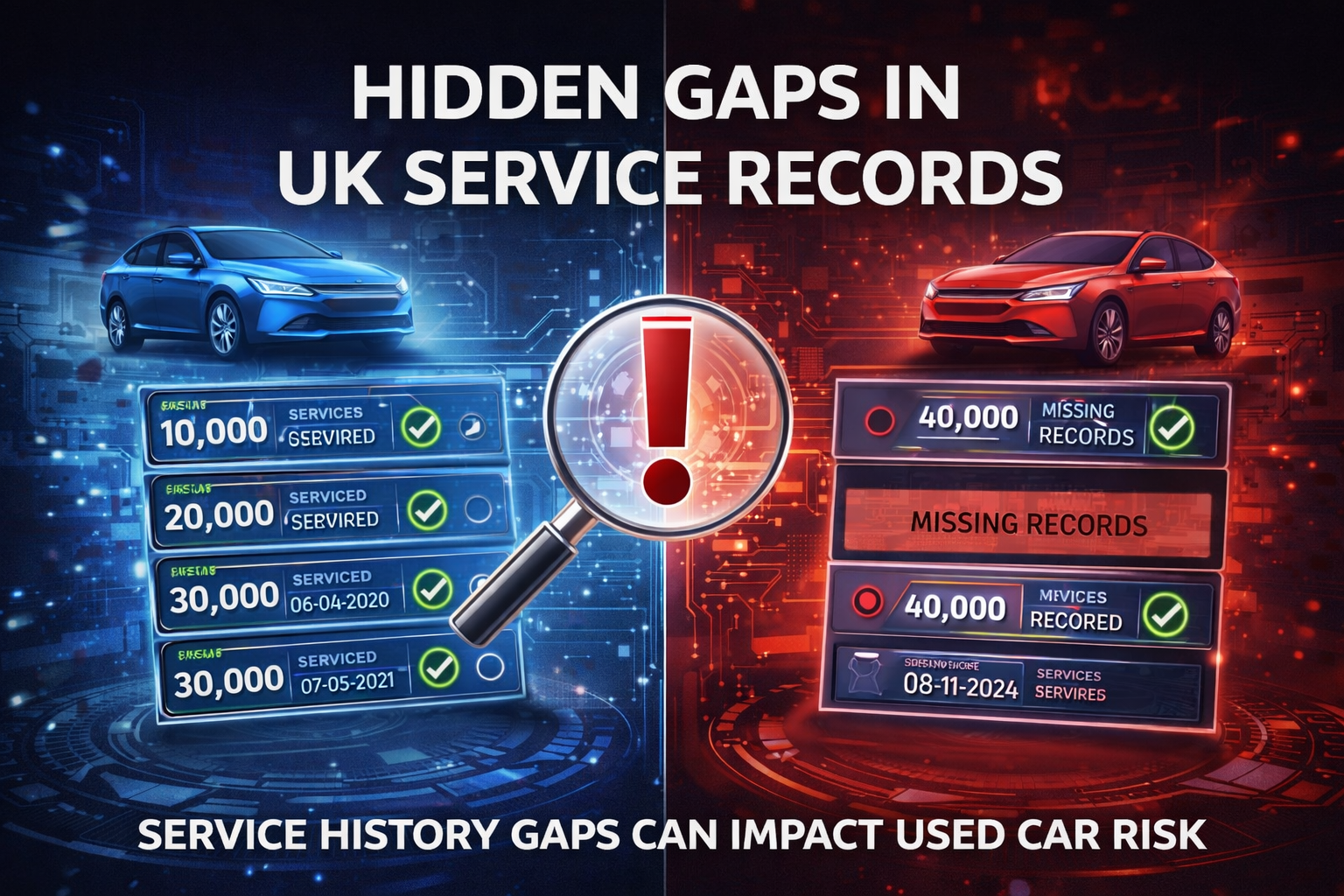

UK Automotive Transparency Analysis – 2026
In the modern UK used car market, buyers increasingly rely on digital tools to evaluate vehicles before committing to a purchase. MOT checks, HPI reports and registration-based lookups have become routine steps. Yet one of the most underestimated risks remains largely misunderstood: hidden gaps in service records.
While a vehicle may appear to have a “full service history” on the surface, closer inspection often reveals inconsistencies between documented servicing, mileage progression and manufacturer-recorded digital entries. These gaps are not always immediately visible — but they can significantly influence long-term reliability, valuation and resale positioning.
What Is a “Hidden Gap” in Service History?
A hidden gap refers to a period in a vehicle’s maintenance timeline where no verified servicing activity is recorded, despite mileage accumulation that would normally require routine maintenance.
These gaps can occur in several forms:
- Extended mileage periods without documented servicing
- Missing entries in manufacturer digital systems
- Paper service books without supporting invoices
- Service stamps that do not align with MOT mileage progression
- Intervals exceeding manufacturer-recommended maintenance schedules
Importantly, a hidden gap does not automatically mean neglect — but it introduces uncertainty. In the context of risk assessment, uncertainty carries weight.
Why Digital Systems Do Not Always Tell the Full Story
Since approximately 2012, many manufacturers have transitioned to Digital Service Record (DSR) platforms. These systems log authorised dealer servicing directly against the vehicle’s VIN. However, independent garage servicing does not automatically populate these databases.
This creates a structural separation between:
- Manufacturer-recorded authorised servicing
- Independent maintenance outside franchised networks
- Paper-based documentation provided by sellers
A vehicle may have been maintained responsibly at independent workshops, yet show limited or no entries in manufacturer systems. Conversely, a vehicle may have partial digital records but large mileage periods between entries.
Understanding this nuance is critical when evaluating what a service history actually represents.
Why Gaps Matter in Practical Terms
Modern engines, turbocharged systems, hybrid drivetrains and advanced transmissions depend heavily on scheduled maintenance intervals. Oil degradation, filter blockage and software calibration cycles are tied to mileage thresholds.
If a vehicle accumulates 20,000–30,000 miles between verifiable servicing events — particularly in high-output or diesel engines — buyers may face elevated mechanical risk.
Even when the vehicle performs well at inspection, undocumented periods can influence:
- Future warranty eligibility
- Extended warranty pricing
- Trade-in appraisal values
- Buyer negotiation leverage
- Insurance risk scoring in certain cases
How Hidden Gaps Typically Appear
In practice, hidden gaps often become visible only when service dates are mapped chronologically alongside MOT mileage data. A common pattern might include:
- Consistent servicing between years 1–3
- No documented entries for years 4–6
- A sudden service entry shortly before sale
This pattern may not indicate misconduct, but it introduces questions about interim maintenance standards.
A deeper breakdown of these patterns is available in this structured explanation of hidden gaps in UK service records.
The Psychological Effect on Buyers
Beyond mechanical considerations, service record gaps affect perception. In private sale scenarios, buyers often interpret incomplete timelines as elevated risk — even if the vehicle has been well maintained.
This perception can reduce market liquidity, extend time-on-market and require price adjustments to offset uncertainty.
Bridging the Transparency Gap
Modern buyers increasingly combine multiple verification layers:
- Government MOT history
- Invoice review
- Manufacturer digital entries
- Physical vehicle inspection
VIN-based manufacturer database analysis adds an additional reference layer when assessing authorised servicing activity. Platforms such as VIN History analyse dealership-recorded digital maintenance entries where data is available, allowing buyers to evaluate whether authorised network records exist.
This does not invalidate independent maintenance — but it clarifies whether manufacturer-logged entries align with seller claims.
Import and Trade Considerations
For trade professionals and import specialists, hidden gaps can complicate resale positioning. Vehicles with clearly documented, consistent timelines often command stronger retail presentation. Conversely, incomplete records may require more detailed disclosure or pricing adjustment.
As the UK market becomes more data-driven, transparency is increasingly rewarded.
The Direction of the Market in 2026
The broader trend is clear: buyers are moving toward structured verification rather than assumption-based trust. Digital systems, VIN-based manufacturer databases and layered checks are reshaping how risk is assessed.
Hidden gaps in service records are not always visible at first glance — but they remain one of the most overlooked structural risks in used vehicle transactions.
In a market where margins are tightening and buyer scrutiny is increasing, understanding maintenance continuity is no longer optional. It is part of informed decision-making.
