
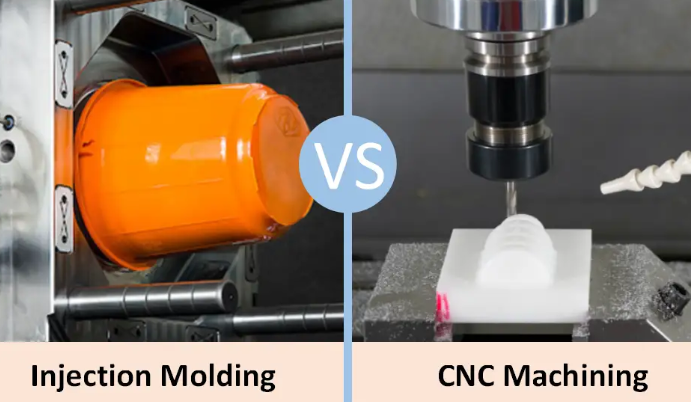

Choosing the right manufacturing process is one of the most critical decisions in product development. In the landscape of modern production, the debate often centers on CNC Machining vs. Injection Molding.
While both are capable of producing high-quality plastic and metal components, they operate on opposed principles: one is subtractive, the other is formative.
As we move through 2026, advancements in AI-driven automation and hybrid manufacturing have narrowed some traditional gaps, but the core economic and technical distinctions remain. This guide provides an exhaustive comparison of these two titans of industry.
1. Fundamental Principles: Subtractive vs. Formative
To understand which process suits your project, you must first understand how they “create.”
CNC Machining: The Subtractive Approach
CNC (Computer Numerical Control) machining is a subtractive process. It starts with a solid block of material (a “billet”) and uses high-speed rotating tools to carve away material until the final shape is achieved.
- Precision: It offers extreme accuracy, often within $\pm 0.025$ mm.
- Flexibility: Since there is no permanent mold, you can change the design by simply updating the CAD/CAM file.
- Speed (Initial): You can go from a digital file to a physical part in hours.
Injection Molding: The Formative Approach
Injection molding is a formative (or additive in terms of filling) process. It involves melting raw material (usually plastic pellets) and injecting it under high pressure into a custom-built metal mold (the “tooling”). Once the material cools and solidifies, the part is ejected.
- Repeatability: Once the mold is perfected, every part is nearly identical.
- Speed (Mass Production): While the mold takes weeks to build, once it’s ready, parts can be produced every few seconds.
- Waste: It is highly material-efficient as excess material in the runners can often be recycled.
2. Economic Analysis: The “Break-Even” Point
The biggest differentiator between these two methods is cost structure.
Initial Investment (Capex)
- CNC Machining: Very low. You only pay for the programming time, material, and machine hours.
- Injection Molding: High. Designing and machining a steel or aluminum mold can cost anywhere from $2,000 to $100,000+ depending on complexity.
Cost Per Unit
In CNC machining, the cost per unit stays relatively flat because the machine must perform the same work for every single part. In injection molding, the cost per unit drops drastically as volume increases because the “Tooling Tax” is spread over more parts.
Production Volume
Preferred Method
Reasoning
1 – 100 units
CNC Machining
No expensive tooling required; fast turnaround.
100 – 500 units
Gray Area
Depends on part complexity and material.
500+ units
Injection Molding
The low per-part cost begins to offset the mold cost.
3. Technical Comparison
Material Versatility
CNC Machining is the clear winner here. It can handle almost any rigid material:
- Metals: Aluminum, Steel, Titanium, Brass, Copper.
- Plastics: ABS, PEEK, Delrin, Nylon, Polycarbonate.
- Others: Wood, Foam, and even Composites.
Injection Molding is primarily limited to thermoplastics and thermoset resins. While “Metal Injection Molding” (MIM) exists, it is a niche and expensive sub-sector.
Tolerances and Precision
CNC machines are inherently more precise. If your part requires a bearing fit or a vacuum seal, CNC is usually necessary.
- CNC Tolerance: Up to $\pm 0.005$ mm for high-end machines.
- Injection Molding Tolerance: Usually around $\pm 0.1$ mm to $\pm 0.2$ mm. Plastic shrinkage during cooling makes ultra-tight tolerances difficult to maintain.
Surface Finish
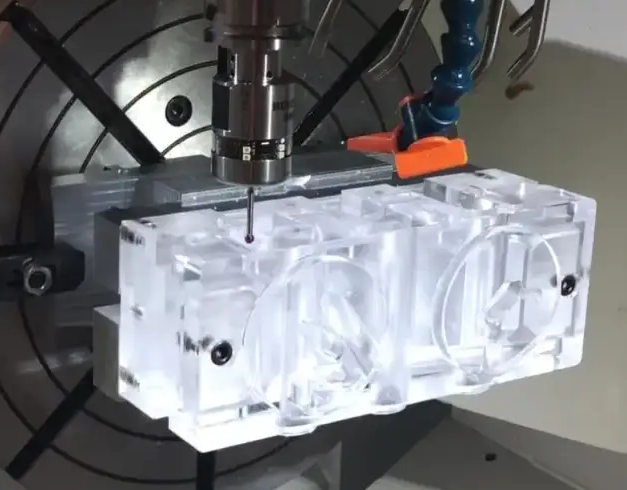
- CNC: Leaves “tool marks” (swirls or lines). Parts often require post-processing (bead blasting, anodizing) for a smooth look.
- Injection Molding: The finish is determined by the mold itself. A polished mold creates a mirror-finish part; a textured mold creates a matte or grain-finished part directly out of the machine.
4. Design for Manufacturing (DFM) Constraints
Designers must follow different rules for each process:
Designing for CNC
- Avoid Deep Cavities: Long tools vibrate and break.
- Internal Corners: Because tools are round, you cannot have perfectly sharp internal 90° corners (radii are required).
- Wall Thickness: Thicker is generally better for stability.
Designing for Injection Molding
- Uniform Wall Thickness: Uneven walls cause “sink marks” and warping.
- Draft Angles: You must taper the vertical walls so the part can slide out of the mold.
- Ribs and Bosses: Instead of thick solid sections, use thin ribs to provide strength without adding mass.
5. Trends in 2026: The “Hybrid” Shift
In 2026, the industry is no longer viewing these as “either/or” choices.
- AI-Optimized Tooling: AI now predicts plastic flow in molds with 99% accuracy, reducing the “trial and error” phase of injection molding.
- Bridge Tooling: Companies use CNC to machine “quick-turn” aluminum molds. This allows them to get 500–2,000 molded parts in days rather than months.
- On-Demand CNC: Automated cloud-based CNC services have made low-volume machining so fast that it has replaced injection molding for many specialized medical and aerospace components.
6. Decision Matrix: Which one should you choose?
Use this checklist to make your final decision:
- Choose CNC Machining if:
- You need fewer than 200 parts.
- The design is likely to change next month.
- The part must be made of metal.
- You need extreme precision (e.g., aerospace components).
- Choose Injection Molding if:
- You need 1,000+ parts.
- The design is finalized and tested.
- Unit cost is the most important factor for retail.
- You need high-quality surface finishes directly from production.
Conclusion
CNC Machining and Injection Molding are the two pillars of modern manufacturing. CNC is the “Explorer”—perfect for finding the right design and producing specialized, high-performance parts. Injection Molding is the “Colonizer”—built to take a proven design and replicate it at a scale and cost that CNC cannot touch.
For most startups, the journey begins with CNC prototypes and ends with injection-molded production. Understanding the transition point between these two is the key to a successful product launch in 2026.
