
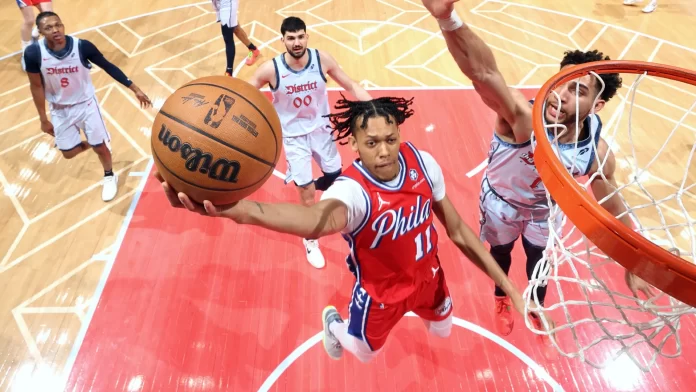

Washington wizards vs 76ers match player stats are more than just numbers on a digital screen; they represent the digital footprint of a relentless battle between two Eastern Conference rivals with vastly different season objectives. When the Wizards and the Philadelphia 76ers meet, the box score often tells a story of star power clashing with a team in transition. For the 76ers, the statistics usually highlight the dominance of a perennial MVP candidate, while for the Wizards, the numbers often reflect a collective effort to find a new identity.
Analyzing these matchups through individual metrics allows fans to see the game within the game. It is about how a specific defensive rotation affects a superstar’s field goal percentage or how a young guard’s assist-to-turnover ratio indicates his growth under pressure. When you look at the washington wizards vs 76ers match player stats, you are witnessing the intersection of elite talent and tactical coaching adjustments that happen in real-time over forty-eight minutes of high-intensity basketball.
The centerpiece of any statistical discussion involving the Philadelphia 76ers is almost always Joel Embiid. His impact on the floor is so massive that it often skews the entire statistical profile of the match. Embiid’s points per game and rebounding totals are standard metrics, but his “gravity”—his ability to draw double and triple teams—creates opportunities for his teammates that show up in the assist and three-point shooting categories. Watching his footwork in the post against the Wizards’ frontcourt is like watching a masterclass in efficiency and power.
Tyrese Maxey has emerged as the perfect statistical complement to the 76ers’ interior game. His speed and outside shooting provide a perimeter threat that makes the 76ers’ offense incredibly difficult to contain. In matchups against the Wizards, Maxey’s stats often show a high volume of transition points, as he looks to exploit any lapses in Washington’s defensive retreats. His ability to maintain a high true shooting percentage while carrying a significant offensive load is a testament to his evolution into an All-Star caliber guard.
Analyzing the Washington Wizards vs 76ers Match Player Stats from the Perimeter
On the other side of the ledger, the Washington Wizards rely heavily on the scoring versatility of Kyle Kuzma. Kuzma’s role as a primary option is clearly reflected in his usage rate and field goal attempts. In games against the 76ers, Kuzma often faces a variety of defensive looks, from physical wings to switching bigs. His ability to contribute in multiple categories—scoring, rebounding, and playmaking—makes his stat line one of the most scrutinized by fans and analysts alike.
Jordan Poole brings a level of scoring volatility to the Wizards that can drastically alter the washington wizards vs 76ers match player stats in a single quarter. When Poole is in a rhythm, his three-point shooting and ability to get to the rim create a dynamic offensive environment. However, his performance is often a bellwether for the Wizards’ success; a high-scoring night with efficient shooting usually keeps Washington in the game, while a struggle from the field can lead to a lopsided box score.
The defensive side of the ball provides equally fascinating data points. The 76ers often utilize a defensive scheme anchored by Embiid’s rim protection, which forces the Wizards to rely on mid-range jumpers and corner threes. The stats for “blocks” and “contested shots” are usually high for Philadelphia when playing at home. For the Wizards, the defensive focus often involves aggressive perimeter pressure to disrupt the 76ers’ passing lanes, leading to “points off turnovers” as a key metric for their success.
Role players also play a significant part in shaping the overall statistical narrative. For the 76ers, players like Kelly Oubre Jr. or Tobias Harris provide the necessary scoring punch to keep the offense moving when the primary stars are resting. Their “plus-minus” ratings often indicate how well the bench unit is holding up against the Wizards’ second unit. In a close game, a few timely buckets from a reserve player can be the difference between a win and a statistical outlier.
The Washington Wizards have looked to their younger core, including players like Bilal Coulibaly, to provide defensive energy and transition scoring. Coulibaly’s defensive win shares and “deflections” are stats that scouts watch closely, as they indicate his potential as a premier two-way player. While his raw scoring numbers might not always pop, his impact on the game’s flow is often visible in the advanced metrics that track defensive efficiency and opponent shooting percentages.
Tactical Shifts in the Washington Wizards vs 76ers Match Player Stats
Coaching philosophies significantly influence individual player stats. Under the leadership of Nick Nurse, the 76ers have implemented a more creative offensive system that emphasizes movement and high-value shots. This has led to an increase in assist totals for several players across the roster. For the Wizards, the coaching focus has been on developing chemistry and finding consistent rotations, which often leads to fluctuating stats for the players at the end of the bench as they fight for permanent roles.
Rebounding is another critical area where the washington wizards vs 76ers match player stats diverge. The 76ers’ size advantage often gives them the edge on the defensive boards, limiting Washington’s second-chance points. However, the Wizards have shown a tenacity on the offensive glass that can sometimes catch the 76ers off guard. Tracking the “rebound percentage” for both teams provides a clear picture of who controlled the physical battle in the paint.
Free throw attempts are a major component of Philadelphia’s offensive strategy. Joel Embiid’s ability to draw fouls is legendary, often leading to a high number of trips to the charity stripe. This not only inflates his scoring totals but also puts the Wizards’ big men in foul trouble, forcing them to play more cautiously or leading to early substitutions. The impact of foul trouble on a team’s rotation is one of those “hidden” stats that fundamentally changes the outcome of the match.
Transition play is where the Wizards often find their most success against the 76ers. By pushing the pace and looking for fast-break opportunities, Washington attempts to negate Philadelphia’s set half-court defense. The “pace” of the game is a vital statistic to watch; a faster game generally favors the Wizards’ young and athletic roster, while a slower, more deliberate pace favors the 76ers’ execution and veteran experience.
Three-point shooting remains the ultimate equalizer in the modern NBA. The 76ers have surrounded their stars with capable shooters who can punish the defense for collapsing on Embiid. The Wizards, meanwhile, rely on a “strength in numbers” approach, with multiple players capable of hitting three or four triples on any given night. The final “three-point percentage” for both teams is often the most accurate predictor of which team walked away with the victory.
Advanced metrics like “Player Impact Estimate” (PIE) and “Net Rating” offer a deeper level of understanding than basic box scores. These stats help fans identify which players are truly moving the needle for their teams. For example, a player might have a modest scoring night but a massive positive net rating because of their defensive positioning and secondary playmaking. These are the nuances that true students of the game look for in the washington wizards vs 76ers match player stats.
The historical context of this rivalry adds another layer of intrigue. Fans remember the legendary matchups of the past, and every new game adds another chapter to the story. Whether it is a blowout win for the 76ers at the Wells Fargo Center or a gritty upset by the Wizards at Capital One Arena, the stats serve as the permanent record of those efforts. They provide the basis for the debates that happen on social media and in sports bars long after the final buzzer has sounded.
For fantasy basketball enthusiasts, these match player stats are the lifeblood of their hobby. Knowing how a player like Tyrese Maxey performs specifically against the Wizards’ defensive backcourt can be the difference between winning a weekly matchup or falling short. The consistency of a player’s statistical output over the course of the season is what makes them a valuable asset, and these head-to-head matchups provide the data points needed to make informed decisions.
Injuries also play a significant role in the statistical landscape. When a key player like Embiid or Kuzma is sidelined, the entire statistical burden shifts to the rest of the roster. This creates opportunities for “breakout” performances from bench players who are suddenly thrust into the spotlight. Watching how the team’s statistical profile changes when a star is absent is a fascinating study in roster depth and coaching adaptability.
The physical toll of an eighty-two-game season is often reflected in the stats as the year progresses. Shooting percentages might dip during a long road trip, or rebounding numbers might surge during a homestand. For the Wizards and 76ers, every game is a data point in a much larger narrative of endurance and resilience. The “per-36-minute” stats can sometimes be more telling than raw totals, as they show what a player is capable of when given a full workload.
The interaction between the stars and the officiating crew also leaves a mark on the box score. Some nights, the game is called tightly, leading to high free throw numbers and foul trouble for both sides. Other nights, the officials “let them play,” resulting in a more physical game with more turnovers and contested shots. These environmental factors are why no two games between the Wizards and 76ers ever look exactly the same on paper.
Individual rivalries within the match also generate interesting data. A specific defensive assignment, like Deni Avdija guarding Tobias Harris, can be tracked through “matchup data.” This level of detail shows exactly how many points a player scored while being defended by a specific opponent. It reveals the successes and failures of individual defensive efforts and provides a roadmap for future game planning by the coaching staffs.
As the NBA continues to embrace the analytics revolution, the way we consume washington wizards vs 76ers match player stats will only become more sophisticated. We will have even more data at our fingertips, from player “tracking data” that measures speed and distance traveled to “shot quality” metrics that evaluate the likelihood of a basket going in. These advancements allow us to appreciate the incredible athleticism and skill of these players in ways that were previously unimaginable.
The fan experience is also enhanced by this wealth of information. Being able to pull up the box score on a smartphone and see the real-time impact of a substitution adds a layer of engagement that makes the game more interactive. Whether you are rooting for the Wizards to pull off an upset or the 76ers to continue their climb up the standings, the stats are the lens through which you see the progress of your favorite team.
Every season brings new players, new coaches, and new storylines to the Wizards vs. 76ers matchup. A rookie making his debut against a seasoned veteran provides a “welcome to the league” moment that is captured in the stats. A veteran player reaching a career milestone in points or assists adds a touch of history to the occasion. These are the moments that make the game special and keep the fans coming back for more.
The 76ers’ quest for a championship and the Wizards’ journey through a rebuild are two very different paths, but they meet on the same hardwood several times a year. The stats they accumulate during these meetings are the milestones of their respective journeys. For the players, the numbers are a reflection of their hard work and dedication. For the fans, they are a source of pride, frustration, and endless fascination.
In the end, the player stats are a tribute to the game of basketball itself. They capture the beauty of a perfectly executed play, the intensity of a defensive stand, and the drama of a buzzer-beating shot. The Washington Wizards and the Philadelphia 76ers continue to provide some of the most compelling statistical narratives in the Eastern Conference. As long as the ball is in the air and the clock is running, the stats will be there to tell the story of the game.
The legacy of the great players who have worn these jerseys in the past—from Wes Unseld and Elvin Hayes to Allen Iverson and Julius Erving—is preserved in the archives of these statistics. The current generation of stars is simply adding their own lines to that storied history. When we look at the box score of a Wizards vs. 76ers game today, we are seeing the modern version of a rivalry that has spanned decades and generations.
Looking ahead, the evolution of these rosters will continue to shift the statistical balance. New draft picks will enter the league, trades will be made, and players will continue to develop their skills. The washington wizards vs 76ers match player stats will always be a dynamic and ever-changing reflection of the league’s talent. Whether it’s a Tuesday night in November or a high-stakes game in April, the numbers will always matter.
The 76ers’ dominance and the Wizards’ resilience are the two themes that define this matchup in the current era. Watching how those themes play out in the points, rebounds, and assists categories is a privilege for any basketball fan. The stats give us a way to quantify excellence and appreciate the grind of a professional career. They are the evidence of the passion that fuels the NBA.
As the lights dim and the players head to the locker room, the box score is finalized, but the conversation is just beginning. Fans will spend hours dissecting every stat, debating every decision, and looking forward to the next time these two teams meet. The Washington Wizards and the Philadelphia 76ers are two pillars of the Eastern Conference, and their statistical battles will continue to captivate the world of basketball for years to come.
